
China produces 28.7% of the world's manufactured goods — over $4.6 trillion annually, according to World Bank data. That single number explains why businesses of every size still source from China, even as tariffs shift and supply chains reorganize.
But "sourcing from China" looks different depending on who you are. A first-time importer worries about getting scammed on a $2,000 sample order. A retail chain with 30 stores needs shelf-ready products that pass CE or FDA compliance. A distributor moving $3 million a year wants to eliminate middlemen and compress landed costs. An overseas trading company managing orders for multiple clients needs reliable eyes and ears on the factory floor.
This guide walks you through the entire sourcing process in five clear steps — from understanding the landscape to calculating your real costs. Skip to the step that matches where you are, or read straight through for the complete picture.
Step 1: Understand the China Sourcing Landscape
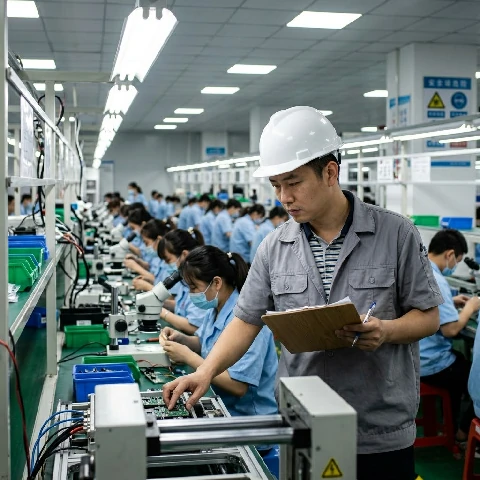
Before you source anything, you need to know who you're buying from. Three types of sellers dominate China's export ecosystem, and confusing them costs importers thousands of dollars every year.
| Factory | Trading Company | Sourcing Agent | |
| What they do | Manufacture your product directly | Buy from factories and resell with a markup | Find factories, manage orders, and inspect quality on your behalf |
| Price | Lowest unit cost (but higher MOQs) | 10-30% markup over factory price | Service fee (5-10%) on top of factory price |
| MOQ | Often 500-5,000+ units | Flexible, sometimes 100+ units | Depends on factory; agent negotiates lower MOQs |
| Communication | Often limited English; factory managers may not respond to emails | Fluent English sales team | Bilingual project manager assigned to your account |
| QC control | You arrange your own inspections | Minimal; they rarely inspect what they resell | Built-in: factory audits, in-line checks, pre-shipment inspections |
| Best for | Experienced buyers with large volumes | Quick, small orders where price isn't critical | Buyers who need on-ground support without opening a China office |
A factory gives you the best price per unit. A trading company gives you convenience. A sourcing agent gives you control without requiring your physical presence in China.
How do you tell which one you're talking to? Check the business license. Manufacturers list production activities in their registered business scope. Trading companies list "import/export" or "trade." A supplier operating from a downtown office tower instead of an industrial zone is almost certainly a trader, not a maker.
The right choice depends on your order volume, your risk tolerance, and whether you have someone on the ground to verify what the factory actually ships. Understanding these three players sets up every decision that follows.
Step 2: Choose Your Sourcing Channel
Now that you know who sells, the next question is where to find them. Four channels dominate supplier discovery — each with a clear sweet spot and a clear limitation.
| Alibaba | Yiwu Market | Trade Shows | Sourcing Agent | |
| Cost | Medium | Lowest (direct from traders) | Travel + time investment | Service fee (5-10%) |
| MOQ | 100-500+ | 50-200 (negotiable on-site) | Negotiable on-site | Agent negotiates for you |
| Language | English | Mandarin only | Mixed | Bilingual |
| QC support | None (Trade Assurance covers payment, not quality) | None | None | Full: audit, DUPRO, PSI |
| Verification depth | "Verified Supplier" badge (limited) | Walk the stalls, see samples | Face-to-face, but limited time | Factory audit + background check |
| Best for | First-timers exploring options; small test orders | Small commodities, gifts, decor buyers willing to travel | Serious buyers ready to commit; relationship building | Multi-client agents, retail chains, and scaling e-commerce brands needing full execution support |
Alibaba is the default starting point. Filter by "Verified Supplier" and "Trade Assurance." But expect 30-50% of listings to be trading companies posing as factories. Treat Alibaba as a discovery tool, not a verification tool.
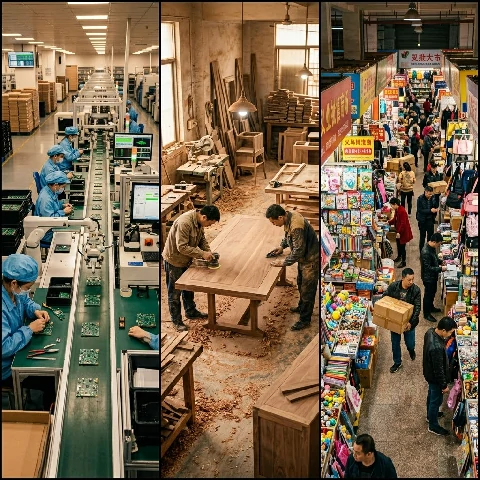
Yiwu Market is the world's largest wholesale market for small commodities. Over 75,000 stalls across five districts sell everything from jewelry and toys to home decor and seasonal goods. Prices run 20-40% lower than Alibaba because you're buying directly from traders who source from nearby factories. The catch? You need to be there in person, speak Mandarin (or hire a local guide), and handle logistics yourself. No buyer protection, no online verification — just cash-and-carry wholesale at its rawest.
Trade shows — Canton Fair (Guangzhou, April/October) remains the gold standard. Face-to-face meetings reveal more in 10 minutes than 50 email exchanges. The downside is cost and time: flights, hotels, and days spent walking exhibition halls.
Sourcing agents skip the search entirely. A China-based agent taps their existing factory network, sends vetted quotes within days, and handles Mandarin communication on your behalf. For overseas trading companies and local agents managing multiple clients, the right sourcing partner operates as a dedicated China execution team — conducting audits, following production, and running inspections under your brand through white-label service.
The hybrid approach works best for most businesses. Use Alibaba or trade shows to discover product categories and shortlist candidates. Then bring in a sourcing agent to verify the factory, negotiate final terms, and manage QC on the ground.
One more variable shapes your channel decision: geography. China's manufacturing clusters specialize by product category, and matching your product to the right region connects you with focused factories instead of generalist traders.
Quick Reference: China's Key Manufacturing Clusters
| City / Region | Specialty | Known For |
| Shenzhen | Electronics, LEDs, PCBs | Consumer tech, IoT devices |
| Yiwu | Small commodities, gifts, decor | World's largest wholesale market |
| Guangzhou | Apparel, cosmetics, leather goods | Canton Fair host city |
| Foshan | Furniture, ceramics, building materials | Export-grade home furnishings |
| Wenzhou | Shoes, eyewear, hardware | Leather goods, fasteners |
| Yangjiang | Knives, kitchen tools | Stainless steel production hub |
| Ningbo | Appliances, auto parts, plastics | Major export port city |
Matching your product to the right cluster cuts supplier search time by 40-60%. Once you've locked your channel and region, you're ready to start executing.
Step 3: Execute the Sourcing Process — From Specs to Shipment
You've chosen your channel. Now you execute. Every successful import follows the same sequence, regardless of whether you're sourcing through Alibaba, a trade show, or an agent. Rushing any step creates problems that compound downstream.
Define Your Product Specifications
Write down every detail before you contact a single supplier. Material, dimensions, weight, color, packaging, labeling, certifications required (CE, FCC, FDA, CPSIA) — all of it. Vague specs produce vague quotes. Vague quotes produce wrong products.
Create a one-page product brief with reference images, a target unit price range, required compliance certifications, and your expected order quantity. This brief becomes your benchmark during every stage that follows — from sample evaluation to final inspection.
Verify Before You Trust
Never send money to an unverified supplier. Check the business license on China's National Enterprise Credit Information Publicity System (NECIPS). Confirm the company name, registered capital, and business scope match what the supplier told you.
Request factory photos showing active production lines — not empty showrooms or stock images. Cross-reference the factory address on Baidu Maps or Google Maps satellite view. A legitimate manufacturer operates in an industrial zone with visible factory buildings. A company listing a residential apartment as its "factory" address is a red flag you don't ignore.
A supplier who hesitates to share basic registration documents is a supplier you walk away from. Full stop.
Order and Evaluate Samples
Samples cost $50-$500 depending on product complexity. Pay for them. Free samples often come from whatever is sitting in stock, not from your actual production specifications.
Evaluate the sample against your product brief line by line. Test durability, finish quality, packaging integrity. If the first sample misses the mark, provide specific written feedback and request a revision. Two rounds of sampling is normal. Four rounds is a red flag.
Negotiate Price, MOQ, and Payment Terms
The first quote is never the final price. But pushing too hard backfires — factories that accept unreasonably low prices cut corners on materials.
Target a 5-15% reduction from the initial quote. Negotiate MOQs by offering a larger follow-up order in exchange for a smaller first batch. Payment terms for first orders typically follow a 30/70 structure: 30% deposit before production, 70% balance after you approve the pre-shipment inspection report.
Experienced distributors often negotiate EXW or FOB terms and arrange their own freight. First-time buyers benefit from CIF or DDP, where the supplier or agent handles shipping logistics.
Arrange Shipping and Clear Customs
Three shipping modes dominate: sea freight (cheapest for large orders, 25-40 days), air freight (fastest, 5-10 days, 4-8x the cost of sea), and rail freight to Europe (a middle ground at 15-20 days). Your product weight, volume, and delivery deadline determine the right mode.
For orders under 15 cubic meters, LCL (Less than Container Load) sea freight makes sense. Once your volume exceeds that threshold, a full 20ft or 40ft container (FCL) drops your per-unit shipping cost dramatically.
Work with a freight forwarder who handles customs documentation, HS code classification, duty calculation, and last-mile delivery. Confirm your HS code before shipment — the wrong classification triggers delays, penalties, or seizure at customs.
Your sourcing process is now complete on paper. But one critical variable determines whether this process delivers profit or pain: quality control.
Step 4: Lock Down Quality at Every Stage
Quality failures in Chinese manufacturing rarely happen because factories lack capability. They happen because nobody was watching. A factory producing for 20 different buyers will prioritize the buyer who inspects, asks questions, and shows up.
According to QIMA's Annual Quality Report, pre-shipment inspection failure rates in China average 25-40% for first-time orders placed without on-site QC supervision. That number drops below 10% when buyers implement a structured inspection chain.
Here is the professional QC chain that protects your sourcing investment at every production stage.
Supplier Audit (Before You Order)
A supplier audit verifies whether a factory can actually deliver what it promises. An auditor visits the facility, checks production equipment, reviews quality management systems, evaluates worker safety conditions, and confirms production capacity matches your order volume.
Skip this step, and you're gambling. Factories that outsource your order to an unvetted subcontractor without telling you — this happens more often than any sourcing blog will admit.
First Article Inspection (Production Start)
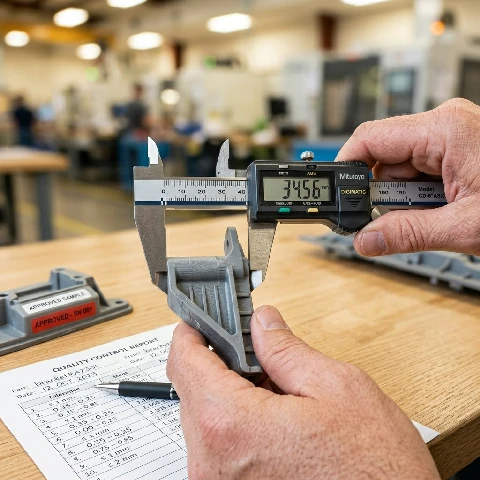
The first 5-10 units off the production line get checked against your approved sample. Material, dimensions, color, functionality — everything gets measured and compared. Catching a deviation here costs nothing. Catching it after 5,000 units ship costs everything.
During Production Inspection — DUPRO (30-50% Complete)
A DUPRO check happens when roughly one-third to half of your order is manufactured. The inspector pulls random samples, checks workmanship consistency, and verifies the factory is using the correct materials and components. This is the last point where corrections remain affordable.
Pre-Shipment Inspection — PSI (100% Complete)
The final gatekeeper. An inspector uses AQL (Acceptance Quality Limit) statistical sampling to examine your finished order. AQL Level II with a 2.5 major defect tolerance is the global standard for consumer goods. The inspector checks quantity, functionality, appearance, packaging, labeling, and shipping marks.
Only after the PSI passes should you release the final 70% payment.
Container Loading Check — CLC
For full container loads, a loading inspection confirms the right goods, in the right quantity, get loaded into the right container. Swapped shipments and short-counts happen at the dock — not at the factory. A CLC eliminates this blind spot.
For overseas agents and trading companies managing multiple clients: every step above can run under your brand through a white-label quality inspection partnership. Your clients see your reports, your letterhead, your standards. The execution happens through a dedicated China-based team that operates as an extension of your business — not a competitor.
With quality locked down, one question remains: what does this entire process actually cost you?
Step 5: Calculate Your True Landed Cost
The factory price on your invoice is never your real cost. Landed cost — the total expense of getting a product from a Chinese factory to your warehouse — includes at least seven line items that many buyers overlook until the first shipment arrives.
Here is a realistic breakdown for a $5.00/unit product shipped by sea (FOB Shenzhen to Los Angeles, 1,000 units):
| Cost Component | Estimated Cost | Notes |
| Product unit cost (FOB) | $5.00 | Negotiated factory price |
| Tooling / mold fee | $0.50 (amortized) | One-time $500 mold cost spread across first 1,000 units |
| Domestic freight to port | $0.15 | Factory to Shenzhen port |
| Sea freight | $0.80 | Based on ~$1,800/20ft container, shared LCL shipment |
| Marine insurance | $0.05 | ~0.3% of cargo value |
| Customs duty (US) | $0.63 | Assuming 12.5% tariff rate on HS code |
| Customs broker fee | $0.15 | Flat fee amortized across units |
| Last-mile delivery | $0.20 | Port to warehouse |
| Total Landed Cost | $7.48/unit | 49.6% above factory price |
That 49.6% gap between factory price and landed cost is where margins disappear. Distributors who negotiate a $0.30 reduction in unit price but ignore a $0.80 freight overpayment lose money while celebrating a "great deal."
Two levers compress landed cost effectively. First, consolidation: combining shipments from multiple factories into a single container eliminates per-factory LCL fees and slashes per-unit freight. A distributor sourcing kitchen tools from Yangjiang and packaging from Dongguan can consolidate both into one FCL shipment through a warehouse in Guangzhou — cutting freight costs by 30-50% compared to shipping separately.
Second, inspection investment: spending $300 on a pre-shipment inspection prevents $3,000-$10,000 in defective goods, returns, and customer chargebacks. The math is straightforward. A single container of rejected goods costs more than five years of inspection fees.
The real question isn't "what's the unit price?" It's "what's my total landed cost per unit, including everything that happens between the factory gate and my warehouse shelf?" Once you can answer that question with a real number, you're sourcing from China like a professional.
Frequently Asked Questions
Is it still safe to source products from China in 2026?
China remains the world's dominant manufacturing hub. Tariff changes (including Section 301 duties and the de minimis suspension) increase costs on certain product categories, but no single country matches China's ecosystem depth. Vietnam's total manufacturing output sits at roughly $57 billion — compared to China's $4.6 trillion. For most product categories, sourcing from China with proper QC and compliance measures remains the most reliable option.
How much money do I need to start sourcing from China?
A realistic starting budget ranges from $1,500 to $5,000. Allocate $200-$500 for samples, $1,000-$3,000 for a small first order, and $300-$500 for quality inspection and shipping. Many factories now accept MOQs of 100-300 units for initial orders.
Do I need a sourcing agent, or can I source directly?
You can source directly through Alibaba or 1688. Direct sourcing works well for simple, standardized products where quality risk is low. For custom products, high-value orders, or situations where you need on-ground QC and production follow-up, a sourcing agent saves time and prevents costly mistakes.
What is AQL inspection and why does it matter?
AQL (Acceptance Quality Limit) is a statistical sampling method that determines how many units from a production batch to inspect and what defect tolerance to accept. AQL Level II with a 2.5 major defect limit is the standard for consumer goods. Without AQL-based inspection, you're either checking every single unit (impractical) or checking nothing (dangerous).
How do I tell if a supplier is a factory or a trading company?
Check the business license for the registered business scope — manufacturers list production activities, while trading companies list "import/export" or "trade." Ask for factory floor photos and videos showing production equipment. A factory based in an industrial zone with production machinery is verifiable. A "factory" operating from the 20th floor of a downtown office building is not.
What are the best cities in China for sourcing specific products?
Shenzhen dominates electronics. Yiwu leads in small commodities and gifts. Guangzhou specializes in apparel and cosmetics. Foshan is the hub for furniture and building materials. Matching your product to the right manufacturing cluster connects you with specialized factories and cuts sourcing time dramatically.
Your Next Step
If you're placing your first order, start with Step 1: understand who you're buying from, then move through the process one stage at a time. If you're an experienced buyer looking to cut landed costs or tighten QC, audit your current supplier relationships against the frameworks in this guide.
And if you need a dedicated team in China — one that conducts supplier audits, manages production follow-up, runs AQL inspections, and ships under your timeline — talk to EJET's sourcing team. We operate as your China-based execution partner, not a middleman.
