

Four sourcing channels. Each works — for the right buyer, at the right stage. Pick wrong, and you burn months chasing quotes that go nowhere.
This article breaks down all four channels with real costs and real trade-offs. No "it depends" filler. This is a deep dive into Step 2 of our complete guide to sourcing products from China.
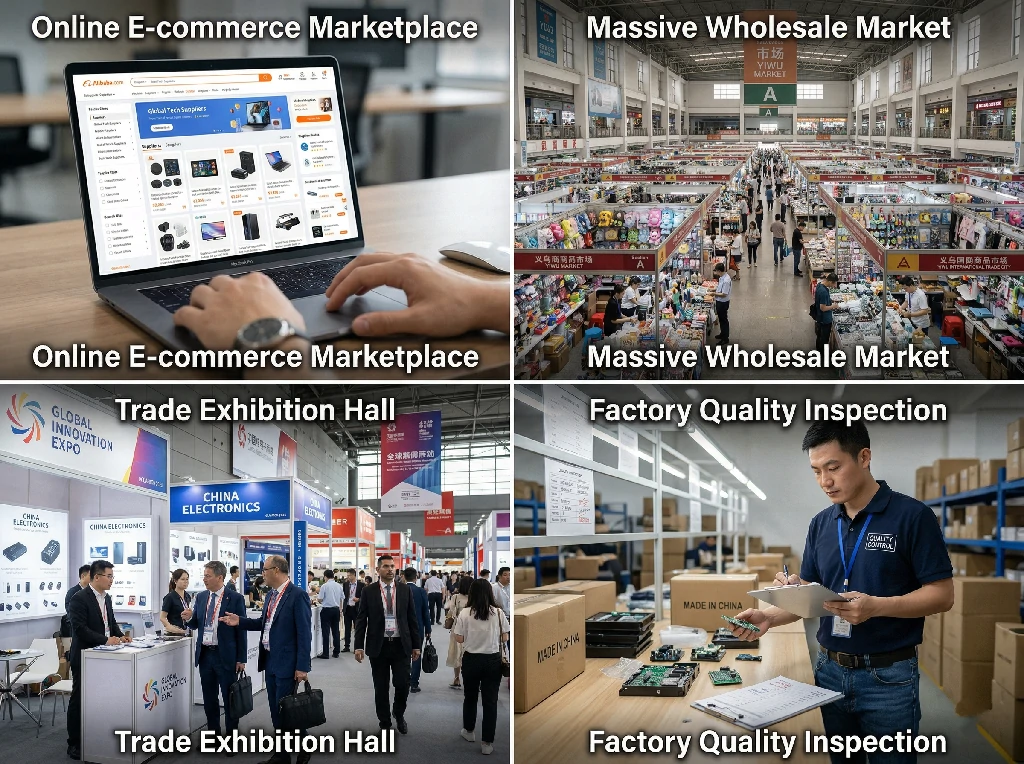
Alibaba — The Starting Line, Not the Finish Line
Alibaba lets you compare 50 suppliers for the same product in one afternoon. The English interface, Trade Assurance escrow, and RFQ system make it the lowest-barrier entry point for first-time importers.
But 30-50% of Alibaba listings are trading companies posing as factories. They mark up prices 10-30% and control nothing in production. The "Verified Supplier" badge confirms a company exists — not that it manufactures anything.
Trade Assurance covers payment disputes. It does not cover quality. A factory ships 5,000 units with a material defect — you might get a refund eventually. You won't get your deadline or your customer back.
Works for: First-time buyers exploring categories. Small test orders under $5,000 with standard specs. Experienced importers who know how to verify suppliers independently.
Breaks down when: Products need custom tooling or certification. Orders exceed $20,000 without a QC plan. You can't spend 2-3 hours daily managing factory communication across time zones.
Yiwu Market — Where Cash Buys What Catalogs Can't Show
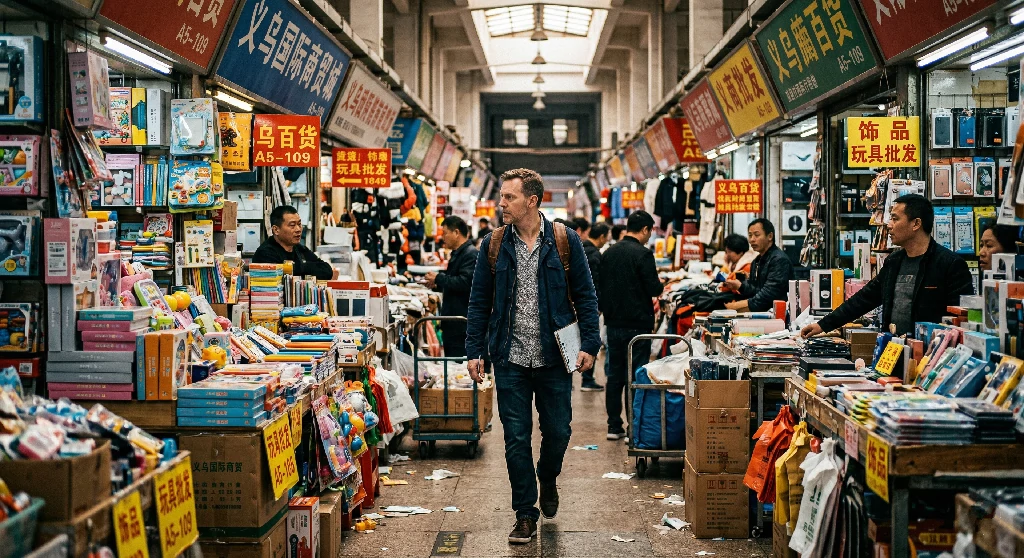
Yiwu International Trade City: 75,000+ booths, 5.5 million square meters, prices 20-40% below Alibaba for the same categories. You cut out platform fees, English sales teams, and digital marketing budgets that online suppliers bake into quotes.
In 30 seconds at a stall, you know the material quality, finish, and weight — three things that take a week of sampling through Alibaba. MOQs start at one carton. Many suppliers are offline-only, invisible to your competitors searching from their desks.
The catch? You need to be there physically. Flights, hotels, and transport run $1,500-3,000 per trip. Most booth operators speak zero English. No buyer protection, no escrow, no dispute system. You pay, pack, and ship — logistics fully on you.
Works for: Small commodities, gifts, decor, seasonal goods. Mixed-order buyers needing 50+ SKUs at low quantities. Buyers willing to travel or hire a Yiwu agent for live-video market tours.
Breaks down when: Products require certifications. You can't arrange Mandarin-speaking support. You need post-sale QC or production monitoring.
Trade Shows — 10 Minutes of Face Time Beats 50 Emails
Canton Fair runs twice yearly in Guangzhou with 25,000+ exhibitors. Ten minutes across a booth table reveals more about a supplier than 50 email exchanges. You see samples, read body language, and verify capabilities face-to-face.
Roughly 30-40% of Canton Fair exhibitors don't sell on Alibaba. These are factories that rely on trade shows and repeat relationships — less competition from other foreign buyers. Walking exhibition halls also surfaces emerging trends before they hit online platforms.
The downside: $3,000-5,000 per trip in flights, hotels, and meals. Each phase lasts five days of 10+ kilometer walks through packed halls. The real killer? Post-show follow-up decay. You return with 40 contacts. Three weeks later, half don't reply. Without Mandarin follow-up, connections expire fast.
For preparation details, read our Canton Fair 2026 guide.
Works for: Buyers committed to a specific category. Annual sourcing trips for relationship building. Large recurring orders.
Breaks down when: You haven't defined product specs yet. Budget can't absorb $3,000-5,000 travel costs. No post-show Mandarin follow-up plan.
Sourcing Agent — Your China Team Without the China Office
A sourcing agent manages sourcing end-to-end on your behalf: finding factories, negotiating prices, monitoring production, running inspections, and coordinating shipping. The typical fee is 5-10% of order value — transparent and separate from the factory price.
This isn't a middleman adding markup. A trading company profits from the spread between factory price and your price. A sourcing agent profits from your repeat business — which only happens if the product arrives right.
Factory access beyond Alibaba. An agent with 5+ years in your product category has a vetted network no platform search replicates. They know which factory actually manufactures, which subcontracts everything, and which failed QC last month.
Full QC chain. Supplier audits before ordering. First Article Inspection at production start. DUPRO checks at 30-50% completion. Pre-Shipment Inspection before container seals. This chain drops defect rates from 25-40% (industry average for unmonitored orders, per QIMA data) to below 10%.
Communication + compliance. Mandarin on the factory floor, English in your inbox. Spec misunderstandings — the top cause of production errors — get caught early. FCC, CE, FDA certification requirements get verified, not just promised.
Works for: Custom products with tooling or certifications. Orders over $10,000. Multi-factory consolidation. Retail chains and trading companies needing on-ground execution.
Breaks down when: Sub-$3,000 test orders for standard products — Alibaba is more cost-effective. You already have your own China-based QC team.
The Real Cost Breakdown
Every channel has a sticker price and a real price that shows up three months later.
| Cost Category | Alibaba | Yiwu Market | Trade Shows | Sourcing Agent |
|---|---|---|---|---|
| Unit cost | Medium | Lowest (20-40% below) | Negotiable | Factory price + fee |
| Platform/service fee | 0-2% Trade Assurance | None | Free to visit | 5-10% of order value |
| Travel | $0 | $1,500-3,000/trip | $3,000-5,000/trip | $0 |
| QC cost | $300-500/inspection (third-party) | None | None | Included |
| Defect exposure | 25-40% failure rate without QC | Varies — no QC chain | Varies — no QC chain | Below 10% with full QC |
A $2.00/unit product on Alibaba looks cheaper than $2.16/unit through an agent (8% fee). One defective shipment flips that math — returns, re-orders, and refunds can double your real unit cost.
For a $3,000 test order, an agent fee doesn't make sense. For a $30,000 run, the $2,400 fee is insurance against a $10,000+ quality failure.
How to Choose — Match Your Stage to the Right Channel
| Your Situation | Channel | Why |
|---|---|---|
| First order, under $5,000, standard product | Alibaba | Low risk, fast discovery, payment protection |
| Small commodities, gifts, decor | Yiwu Market | Lowest prices, carton-level MOQs |
| Exploring a new product category | Trade show + Alibaba | Face-to-face discovery, then online follow-up |
| Custom product with tooling or certs | Sourcing agent | Specs management, QC, and compliance |
| Recurring orders $10,000+ | Sourcing agent | Fee pays for itself through QC savings |
| Experienced importer with China staff | Direct factory | You already have the infrastructure |
The hybrid approach: Use Alibaba for discovery. Attend one trade show for face-to-face verification. Bring in a sourcing agent for execution on orders that matter. Once a factory delivers 3-5 successful orders through your agent, transition to a direct relationship. That's how businesses grow from first sample to annual contracts.
FAQs
Is a sourcing agent worth it for small orders?
For standard products under $5,000, probably not — the fee eats margins on small batches. Once orders pass $10,000 or involve custom specs, the agent fee pays for itself through QC savings.
Can I find suppliers on Alibaba and then hire an agent to manage them?
Yes — this is one of the most cost-effective approaches. Alibaba handles discovery and shortlisting. The agent verifies factories, manages production, and runs QC. You get discovery power plus on-ground execution.
How do I tell if an Alibaba supplier is a factory or trading company?
Check the business license for "manufacturing" in the registered scope. Cross-reference the address on satellite maps — real factories sit in industrial zones, not office towers. Ask for a live video tour of the production floor. Hesitation is your answer. Full verification checklist in our supplier verification guide.
What's the difference between a sourcing agent and a trading company?
A trading company buys from factories and resells at a markup — they work for their margin. A sourcing agent charges a transparent fee and works for your interests. The difference: who they serve. A trading company serves their own profit. An agent serves your repeat business.
