

.webp)
The unit price you negotiate is rarely more than 65-75% of what the product actually costs you. The other quarter hides in eight line items no supplier prints on a quote — and that's where importers quietly bleed margin.
Landed cost is the total spend to move a product from a Chinese factory floor to your warehouse shelf, including every fee in between. Most buyers can recite their FOB price to the cent and have no idea what their landed cost is. That gap is the most expensive blind spot in sourcing.
This is a deep dive into Step 5 of our complete guide to sourcing products from China.
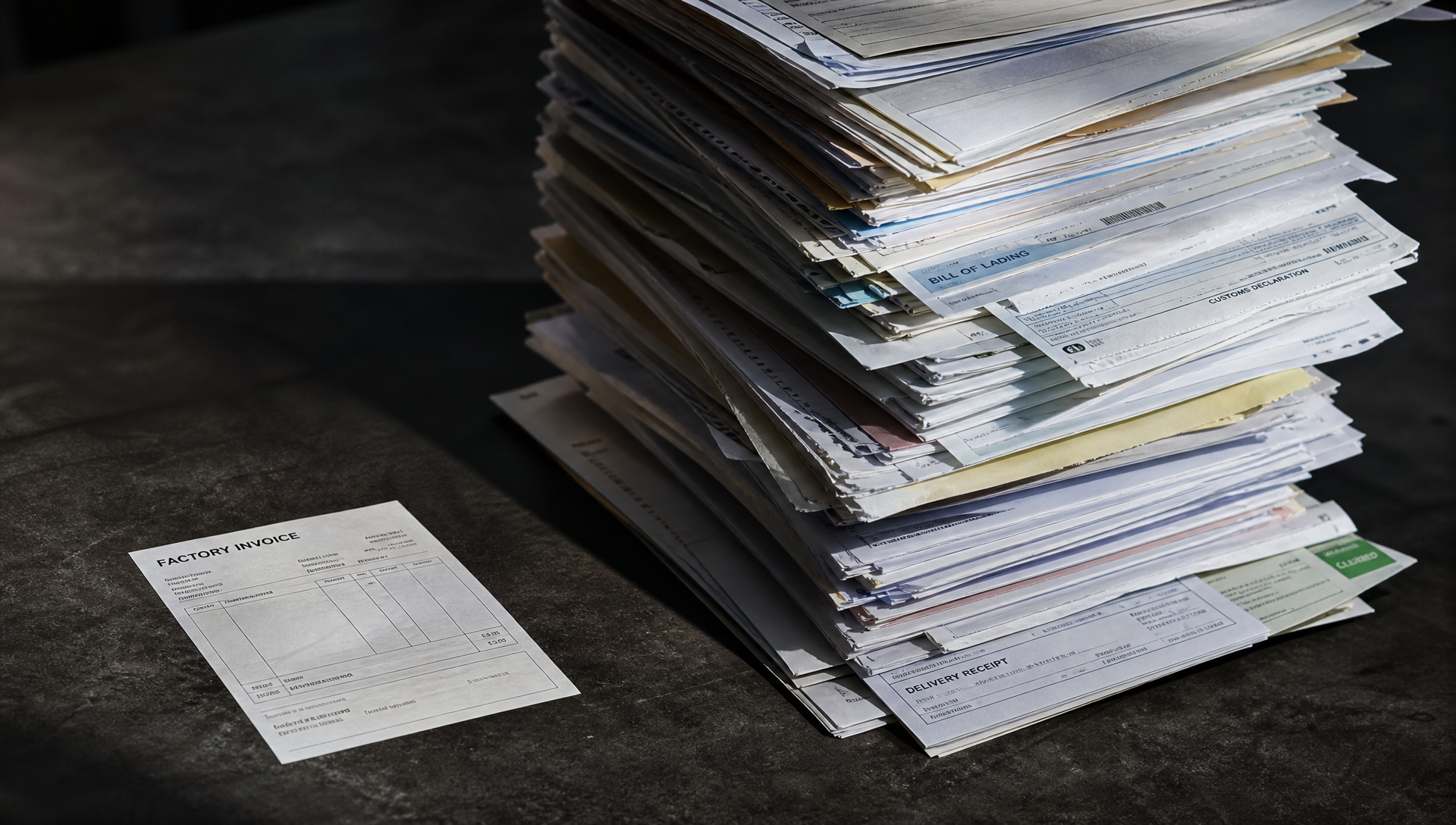
The Landed Cost Formula — Every Line Nobody Quotes You
Landed cost = product cost + freight + insurance + duties and tariffs + brokerage + last-mile + compliance + financing.
Eight inputs. Your supplier is motivated to make exactly one of them look good. Here's what each actually covers and who controls it.
| Cost Line | What It Covers | Typical Size | Who Quotes It |
|---|---|---|---|
| Product cost (FOB/EXW) | Factory unit price + tooling, amortized | 65-75% of total | Supplier |
| Freight | Sea, air, or rail; LCL vs FCL | 8-20% | Forwarder |
| Insurance | Cargo cover, loss or damage in transit | 0.3-0.5% of value | Forwarder |
| Duties + tariffs | Import duty by HS code, plus surcharges | 0-35%+ | You / customs |
| Brokerage | Customs filing, HS classification, docs | Flat $100-300/shipment | Broker |
| Last-mile | Port to your warehouse door | 2-5% | Forwarder |
| Compliance / QC | Inspections, lab tests, certifications | $300-500/inspection | You |
| Financing / FX | Deposit float, wire fees, currency spread | 1-3% | Your bank |
Two lines ambush first-time importers. Tariffs swing the widest — a product at 0% under one HS code can carry a 25% Section 301 surcharge under a neighboring one, so a single misclassified digit reshapes your entire margin. And financing quietly skims 1-3% through wire fees and the FX spread your bank rarely discloses.
The unit price is the only number your supplier wants to look attractive. Every other line is yours to manage — which is exactly why the cheapest quote so often costs the most.

Run the Numbers — Why the Cheapest Quote Loses
Two factories quote the same kitchen gadget, 2,000 units. Supplier A wins the FOB price by 6%. Supplier B wins where it counts.
| Per Unit (2,000 units) | Supplier A (lowest FOB) | Supplier B (hub + QC) |
|---|---|---|
| FOB unit price | $4.20 | $4.45 |
| Domestic freight to port | $0.18 (inland Jiangxi) | $0.06 (20 min from Ningbo port) |
| Sea freight | $0.72 (solo LCL) | $0.34 (consolidated FCL slot) |
| Duty (8% of FOB) | $0.34 | $0.36 |
| Insurance + brokerage + last-mile | $0.27 | $0.27 |
| Defect / return reserve | $0.31 (no QC) | $0.05 (DUPRO + PSI) |
| Landed cost | $6.02 | $5.53 |
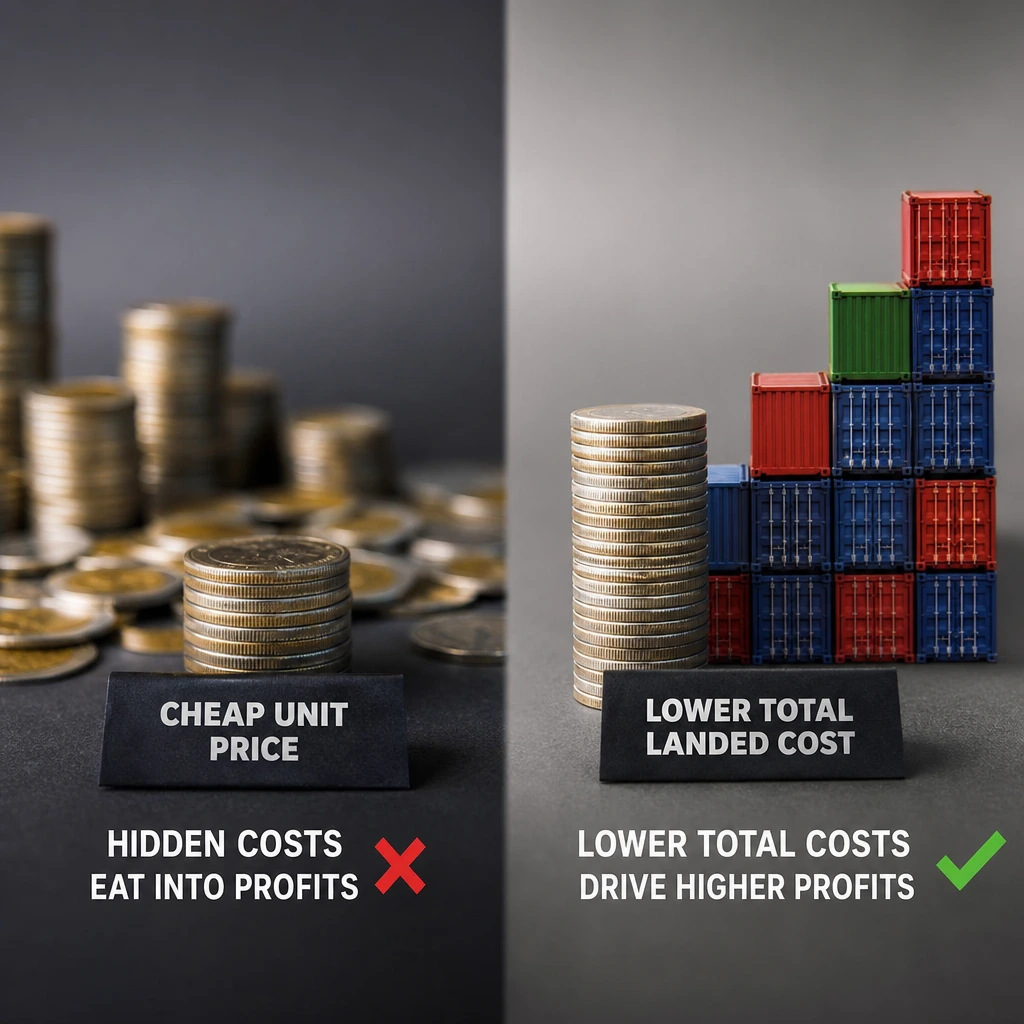
Supplier B's sticker price is 25 cents higher, yet its landed cost runs 49 cents lower — roughly $980 saved across the order. The cheapest unit price and the lowest landed cost are rarely the same supplier.
The defect reserve is the line most buyers leave at zero. It shouldn't be. Pre-shipment inspection failure rates average 25-40% on unmonitored first orders, and every rejected carton, chargeback, and replacement run lands back in your landed cost weeks after you celebrated the "cheap" quote.
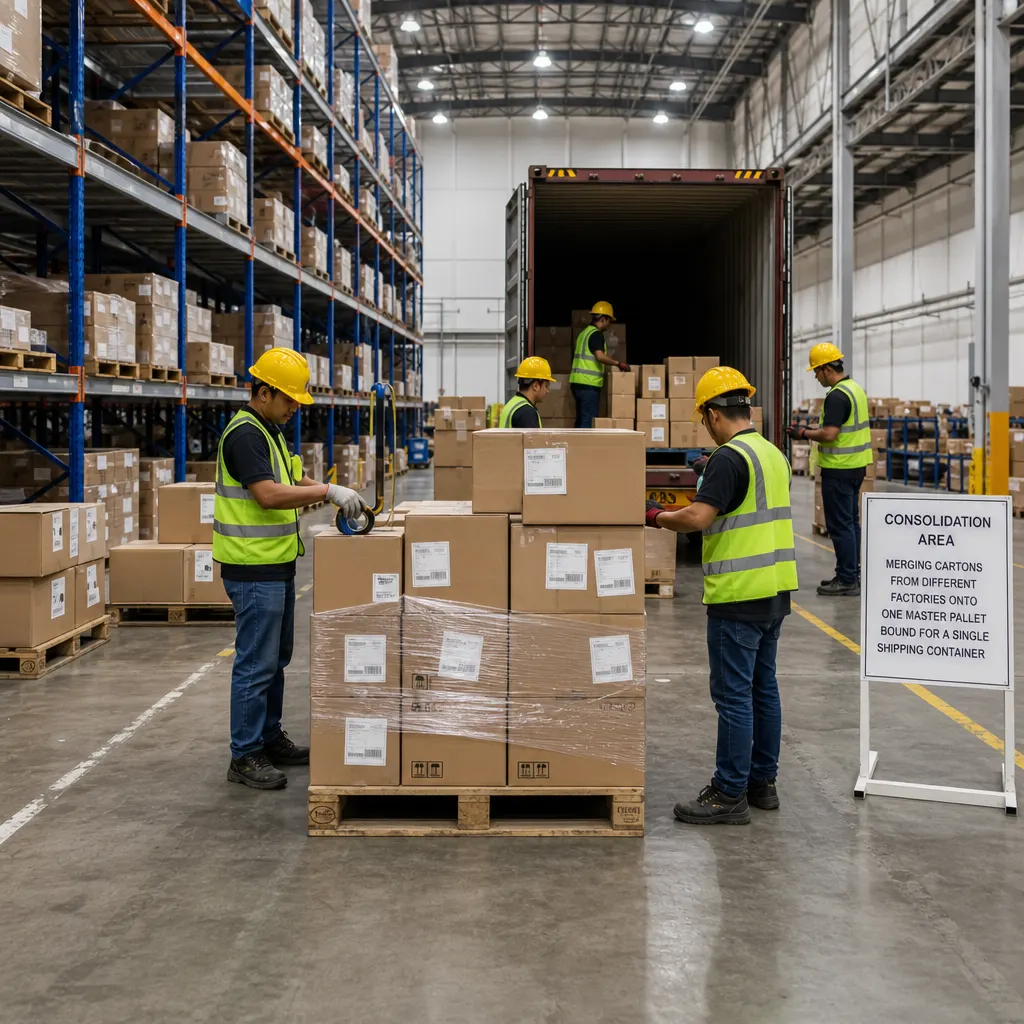
Cut Landed Cost — Four Levers That Actually Move the Number
Shaving the unit price is the lever everyone pulls and the one with the least slack. The real savings sit in the lines you weren't negotiating.
Consolidate before you ship. Sourcing five products from five factories means five LCL shipments, five sets of docs, and five rounds of handling fees. Routing all of them through one warehouse and into a single FCL container cuts per-unit freight 30-50%. A retailer pulling seasonal decor from Yiwu, ceramic housewares from Foshan, and hand tools from Yangjiang into one consolidation point pays freight once, not three times. This is where a China-based consolidation and freight partner changes the math — they hold your multi-factory orders and ship them as one.
Choose the Incoterm on purpose. DDP feels easy because someone else handles everything — but "everything" includes a freight-and-duty markup you never see itemized. On recurring orders above roughly $20,000, take FOB and control your own forwarder; you'll see every line and negotiate each one. Reserve DDP for first orders where simplicity is worth the premium.
Confirm the HS code before you ship, not after. The wrong classification triggers overpaid duty at best and seizure or penalties at worst. Have your broker verify the code against the actual product spec — material, function, and use — before the container leaves. A 6-digit difference can move your duty rate by 20 points.
Spend on QC to protect the other seven lines. A $300 inspection that catches a defective run prevents $3,000-$10,000 in returns, replacements, and lost customers. That's not a cost line — it's the cheapest insurance in the entire formula. Buyers who skip it to save $300 routinely pay it back tenfold on the first bad batch.
For the full inspection chain that keeps the defect reserve near zero, see how the right sourcing channel handles QC on the ground.
Landed Cost FAQs
What is landed cost when importing from China?
Landed cost is the total spend to move a product from a Chinese factory floor to your warehouse shelf — product price plus freight, insurance, duties, brokerage, last-mile, compliance, and financing. The FOB unit price you negotiate is only 65-75% of that total. The remaining quarter hides in eight line items no supplier prints on a quote.
How do I calculate landed cost from China?
Add eight inputs: product cost (FOB/EXW), freight, insurance, duties and tariffs, brokerage, last-mile delivery, compliance/QC, and financing/FX. Build them into a spreadsheet, plug in real freight and duty figures, and add a defect reserve based on whether anyone is inspecting. Compare suppliers on that bottom-line number, not the FOB sticker.
Is DDP cheaper than FOB for landed cost?
No, not on recurring volume. DDP bundles a freight-and-duty markup you never see itemized, so it quietly costs more on orders above roughly $20,000. Take FOB on repeat orders to control your own forwarder and negotiate every line. Reserve DDP for first orders where simplicity is worth the premium.
How much can consolidation cut my freight cost?
Routing multi-factory orders through one warehouse into a single FCL container cuts per-unit freight 30-50% versus shipping each factory's order as separate LCL. Five factories means five LCL shipments, five sets of docs, and five rounds of handling fees — consolidation collapses that into one.
Why does the wrong HS code raise landed cost?
A misclassified HS code triggers overpaid duty at best and seizure or penalties at worst. A 6-digit difference can move your duty rate by 20 points — a product at 0% under one code can carry a 25% Section 301 surcharge under a neighboring one. Have your broker verify the code against the actual product spec before the container ships.
Does paying for QC actually lower landed cost?
Yes. A $300 inspection that catches a defective run prevents $3,000-$10,000 in returns, replacements, and chargebacks. Pre-shipment failure rates average 25-40% on unmonitored first orders, so the defect reserve is the line that quietly inflates landed cost weeks after the "cheap" quote. QC is the cheapest insurance in the formula.
Your Next Step
Build the eight-line formula into a spreadsheet before you accept your next quote. Plug in real freight, duty, and a defect reserve based on whether anyone is inspecting — then compare suppliers on the bottom line, not the top one.
Do that once and the question stops being "who's cheapest per unit?" It becomes "who lands cheapest at my door?" Those are different suppliers more often than not, and knowing which is which is the difference between a margin you keep and a margin you only thought you had.
