


A Yiwu market visit checklist is a structured pre-trip, on-site, and post-trip workflow that ensures global buyers leave the world's largest small commodities market with confirmed suppliers — not just a stack of business cards.
"According to the World Trade Organization, China remains the world's largest exporter — and Yiwu alone supplies an estimated 70% of the global small-commodities trade."
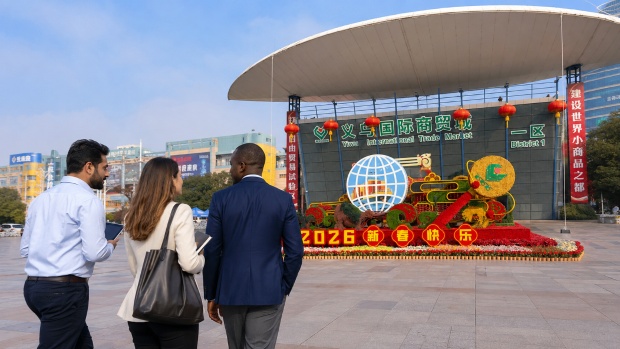
Yiwu Market (Yiwu International Trade City, 义乌国际商贸城) is China's largest wholesale hub, operated by Yiwu China Commodity City, housing over 75,000 booths across 6 districts and supplying buyers in 230+ countries.
The cost of skipping this checklist is high. Most first-time buyers spend $2,000–$3,000 on a single trip with flights, hotels, transport, samples, agent fees, and still return home empty-handed because they walked in unprepared. They get overwhelmed by the scale, misled by trader booths posing as factories, and lose track of which booth quoted what.
This guide replaces guesswork with a 3-phase checklist: Before (preparation), During (on-site execution), and After (post-trip follow-up). Each phase depends on the others. Skip one and you waste the other two.
For a broader overview of the market itself, read our pillar Yiwu Market Guide. The rest of this article is operational: what to do, when, and how.
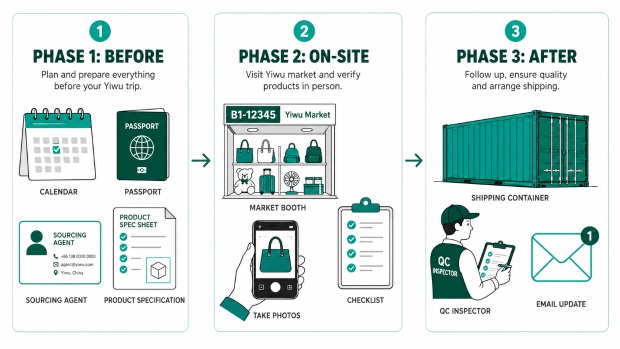
PHASE 01Pre-Trip Checklist (2–6 Weeks Before You Fly)
Phase 1 of the Yiwu market visit checklist covers everything that must happen before your plane takes off, including documents, product specs, and supplier shortlisting. Get this phase wrong the trip is already half-lost.
Most buyers underestimate prep time. Two to six weeks is realistic: visa processing, a working product spec sheet, a shortlist of 10–20 booths to visit, and an agent booking if you're using one. Walking in with vague product ideas guarantees vague quotes.
Documents, Visa & Logistics (2026 Update)
China expanded its visa-free and transit-visa policies through Feb. 17, 2026. Citizens of 50 countries (including France, Germany, Italy, Spain, Netherlands, Switzerland, Australia, and others) enjoy 30-day visa-free entry confirmed by China's Ministry of Foreign Affairs. Most other passports qualify for the 240-hour (10-day) visa-free transit, also sufficient for a focused Yiwu trip when entering via major hubs like Shanghai or Hangzhou. Always confirm current eligibility on the Chinese embassy website before booking.
Book a hotel within walking distance of Yiwu International Trade City (Futian area). For daily expenses in Yiwu, set up Alipay or WeChat Pay before arrival and try linking an international bank card. International card support has improved, but acceptance may still depend on your card issuer, verification status, merchant payment code, and transaction type. Carry some RMB cash as backup for small purchases, taxis, or suppliers who do not accept international card-linked payments.
Product Specs & Supplier Shortlist
Before flying, build a product spec sheet for each SKU: material, dimensions, weight, packaging, target FOB price, target MOQ, and certification needs (CE, FDA, RoHS). Without this, every booth quote will be impossible to compare apples-to-apples.
Pre-shortlist suppliers using Yiwugo.com (the official online directory of Yiwu Market booths) and Alibaba. Save 10–20 booth numbers and coordinates per category. If your product category is unfamiliar or your budget is tight, book a local sourcing agent now (good Yiwu agents fill up fast in peak seasons: March–May, September–November).
Pro Tip: Print 30 copies of your product spec sheet to hand to suppliers on the spot. It signals professionalism and locks each booth into quoting the same product, eliminating apples-to-oranges price comparisons.
PHASE 02On-Site Checklist (Your Days at the Market)
Phase 2 is where 80% of Yiwu sourcing journey succeeds or fails. The on-site checklist exists for one reason: Yiwu is too large to "explore." With six districts and over 75,000 booths, a wandering buyer is a wasted buyer.
The two on-site decisions that matter most are which districts to visit and how to vet each booth. Get both right and you'll leave with quoted, sampled, and shortlisted suppliers. Get them wrong and you'll leave with photos of products you can't trace.
District Routing — Focus on 1–2 Districts, Not All Six
Yiwu International Trade City is split into six districts (Districts 1–6), each grouped by product category. The biggest mistake first-time buyers make is trying to "see them all." You can't. A single district is multi-storey, multi-kilometre, and physically impossible to finish in one day.
In EJET Procurement experience, most buyers manage one or two floors before their eyes glaze over.
The rule: identify the 1–2 districts that match your category and stay focused there.
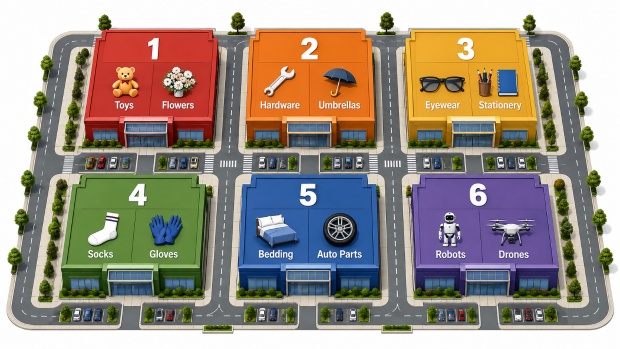
If you sell eyewear and sports goods, you live in District 3 for two full days. If you sell home textiles, Districts 4 and 5. Skip the rest because you don't have time, and exhaustion kills negotiation quality.
The 5-Question Booth Vetting Script
At every booth that looks promising, ask these five questions in order:
Ask to see the business license: 生产 means manufacturer, 贸易 means trader.
Stock items usually have lower MOQs; OEM / custom orders require higher MOQs due to logo printing, packaging, material changes, or production setup.
Stock samples are usually faster; custom samples take longer and may involve sample fees. Some suppliers refund the sample cost after a bulk order.
Standard: 30% T/T deposit, 70% before shipment.
Ask for a bill of lading, packing list, commercial invoice, or export declaration. Sensitive information can be covered, but the document should prove real export experience.
Take a photo of every booth's business card next to the product you discussed. Yiwu booths look identical after two hours, and matching samples to suppliers later is impossible without a visual log. Label every sample on the spot with booth number, date, and quoted price.
PHASE 03Post-Trip Checklist (After You Fly Home)
Phase 3 is the phase 90% of other Yiwu market guides ignore, and the phase where deals are actually closed. A Yiwu visit doesn't end when you board the plane home; it ends when goods clear customs in your country.
Follow a sequential timeline.
A Yiwu trip that ends without QC and a confirmed shipping plan is still incomplete.
Cost Breakdown, Top Mistakes & Should You Hire an Agent?
A realistic Yiwu market visit costs $2,000–$3,000 for a 5-day trip from most countries. Knowing the breakdown and the mistakes that inflate it separates buyers who break even on their first order from those who don't.
5-Day Trip Cost Breakdown (USD)
Top 5 Mistakes First-Time Visitors Make
Visit Alone vs. With a Sourcing Agent
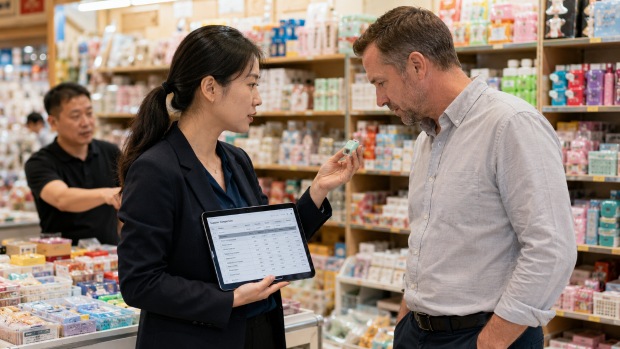
Going alone is cheaper but riskier: language barriers, no factory verification, no leverage on price. Going with a sourcing agent costs $100–$200/day and unlocks Chinese-language negotiation, on-the-spot factory checks, payment safety, and post-trip QC coordination.
5-Day Trip → 8 Confirmed Suppliers
A UK-based home & garden retailer (annual sourcing budget ≈ $320,000) contacted EJET in March 2025 ahead of their first Yiwu visit. We pre-shortlisted 24 booths across Districts 1 and 5, accompanied them for 4 on-site days, and arranged 3 factory tours in nearby Jinhua. Result: 8 confirmed OEM suppliers, sample lead time cut from 21 to 9 days, and a 17% average price reduction vs. their previous Alibaba quotes. First container shipped FOB Ningbo six weeks after the visit.
For buyers placing orders above $3,000, the agent fee usually pays for itself within the first corrected quote. EJET Procurement provides Yiwu market accompaniment, supplier verification, and end-to-end sourcing. We are built for buyers who want one trip to secure confirmed suppliers, not to face follow-up problems.
Conclusion: Turn Your Yiwu Visit into Confirmed Suppliers
A Yiwu market visit checklist works when it's executed as three phases: Before, During, and After. Prepare your specs and shortlist in advance, focus on the 1–2 districts that match your category, vet every booth with the 5-question script, and follow through with samples, QC, and shipping after you return.
For the full picture of Yiwu, its history, and its scale, contact us to get the Yiwu Market Guidebook. When you're ready to plan your trip, talk to EJET as your sourcing agent. We'll help you turn a Yiwu visit into a working supply chain.
Plan a Yiwu Trip That Actually Pays Off
Pre-shortlisted booths · On-site translation · Post-trip QC
Get Free QuoteSource note: Market size, booth numbers, product categories, visa rules, and payment availability may change over time and can vary by market scope. This guide uses publicly available sources such as Yiwu Index, Xinhua, Chinagoods, China’s National Immigration Administration, and official payment-provider information. Buyers should always verify visa, payment, and customs requirements through official channels before travel or payment.
FAQ
1. How many days do I need to visit Yiwu Market?
Plan 3–5 working days. Two days for your chosen 1–2 districts, one day for factory visits, and one buffer day for sample collection and follow-up meetings.
2. Do I need a visa to visit Yiwu Market in 2026?
Many nationalities qualify for 30-day visa-free entry or 240-hour transit. Always confirm with the nearest Chinese embassy before booking flights.
3. What is the best time of year to visit Yiwu Market?
March–May and September–November are peak sourcing seasons. Avoid Chinese New Year (late January–February) when most booths close for 2–3 weeks.
4. Can I buy directly from Yiwu Market without a sourcing agent?
Yes, but expect language barriers, payment risk, and no factory verification. Agents are recommended for first-time buyers and orders above $5,000.
5. What is the typical MOQ at Yiwu Market?
Stock items: often as low as 1 carton (24–144 pieces). OEM / custom orders: usually 500–1,000 pieces depending on the supplier.
6. How do I ship products from Yiwu Market home?
Use a freight forwarder. Goods consolidate in Yiwu warehouses, then ship FOB Ningbo (sea freight) or via the Yiwu–Europe rail link.
7. Is Yiwu Market cheaper than Alibaba?
Often 10–30% cheaper for small commodities because you skip Alibaba's middleman layer. The trade-off is trip cost — usually justified for orders above $5,000.
