

_结果2.webp)
Most importers who tell me they "got a great deal from a Chinese supplier" don't actually know who they were buying from. They sent money to someone who sent product back. Whether that someone was a factory, a trading company, or a sourcing agent — they couldn't say.
That confusion is expensive. The cheapest quote almost never wins on landed cost, and the cheapest partner almost never wins on total cost. In 2026, with shipping volatility, tariff shifts, and tightening compliance, the gap between picking the right intermediary and the wrong one is wider than it's been in a decade.
They Sound Similar — But They're Not the Same Animal
A trading company buys inventory from factories and resells it to you. They own the goods on their books, they choose the supplier, and they quote you a single price with the margin baked in. You never see the factory's number. You may never know which factory made your product.
A sourcing agent works for you. They don't own inventory. They find suppliers based on your specifications, negotiate on your behalf, and show you a transparent breakdown: factory price + service fee + logistics. The relationship is fiduciary in spirit — they get paid to represent your interests, not the factory's.
The third option — buying direct on Alibaba — sounds cheaper than both. For some products it is. For most first-time importers in 2026, it's the path with the highest hidden cost, because you're acting as your own QC team, your own translator, and your own legal recourse — without any of the local infrastructure.
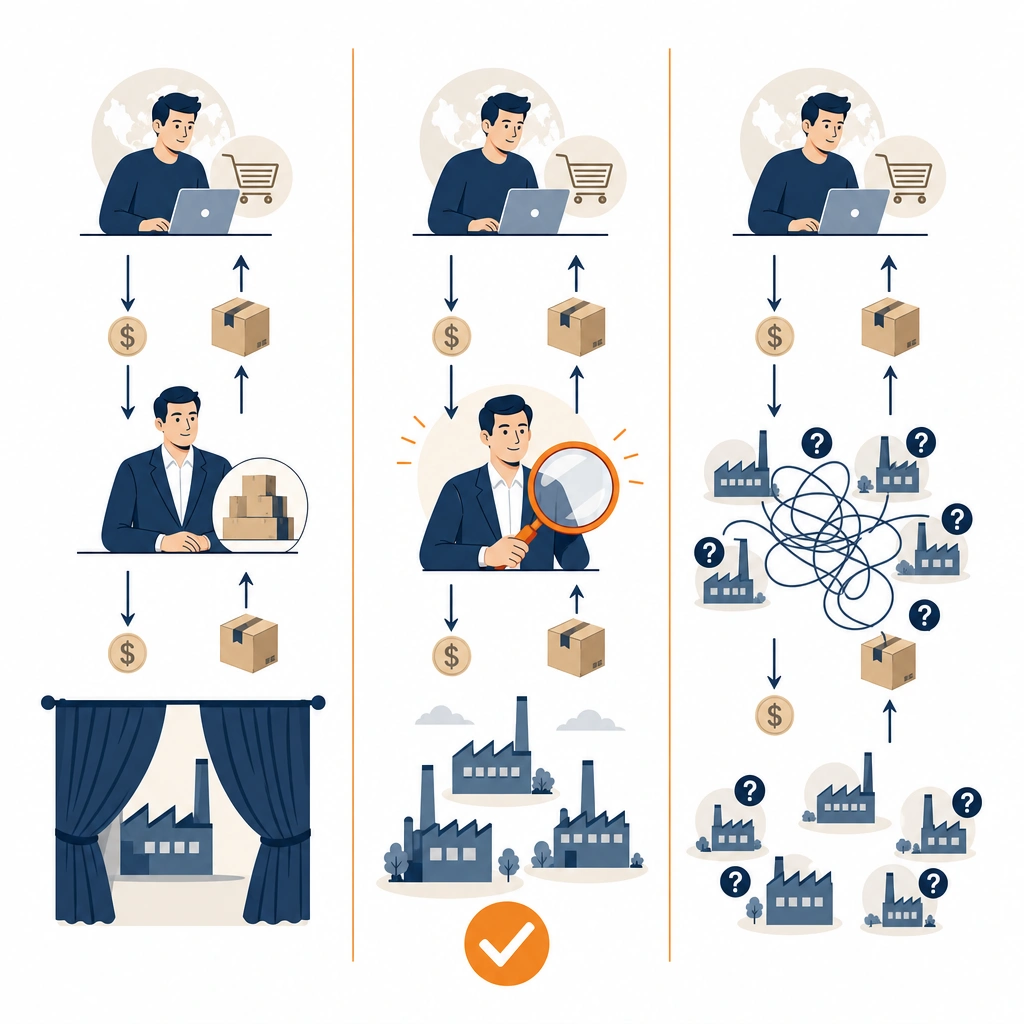
The True Cost of a Trading Company
The pitch is convenience. One contact, one invoice, one shipment. For small commodity orders under $5,000 with no customization, that convenience often justifies the markup.
The cost shows up at three points.
First, the margin. Trading companies typically add 15–30% on top of factory price. Some specialty traders charge more. You won't see the number — it's inside the unit price you're quoted.
Second, the optimization gap. Trading companies push their existing supplier relationships, not the best supplier for your specification. If their go-to factory for kitchenware doesn't make exactly what you need, you'll get a "close enough" version rather than a custom match. For standardized products this is fine. For anything with brand, packaging, or compliance requirements, it costs you.
Third, the leverage problem. When quality goes wrong, you have no relationship with the factory. The trading company becomes the middleman in your complaint — and they have an incentive to keep you calm rather than make the factory pay. I've watched importers wait three months for replacement units because the trading company didn't want to burn the factory relationship over one client's defect rate.
The True Cost of a Sourcing Agent
Agent commissions in 2026 run 3–10% of order value for individuals and small agencies, 8–12% for full-service providers handling QC, warehousing, and consolidation. Flat-fee structures of $2,500–$9,000 per project are increasingly common for buyers who want predictable costs.
That fee buys three things a trading company structurally can't deliver.
Sourcing optimization. A good agent gets quotes from 3–5 pre-qualified factories for your exact specification. Even after the fee, the spread between the highest and lowest qualified quote is usually wider than the agent's commission. Net to you: lower unit cost and better fit.
Independent QC. The agent doesn't make the product. They have no incentive to defend defects. Pre-production checks, mid-production inspections, and pre-shipment AQL sampling become standard — not extras you have to fight for.
Multi-factory consolidation. When you scale past one product, a sourcing agent collects goods from factories in different provinces into a single shipment. The freight savings on a consolidated 40-foot container versus three LCL shipments can hit 40–60%. A trading company won't do this because each factory is a competitor for the next order.
The risk: not all agents are transparent. Some quote 5% and earn another 15–20% in factory kickbacks baked into the "factory price" they show you. That's why vetting matters — but the red flags are predictable once you know what to look for.
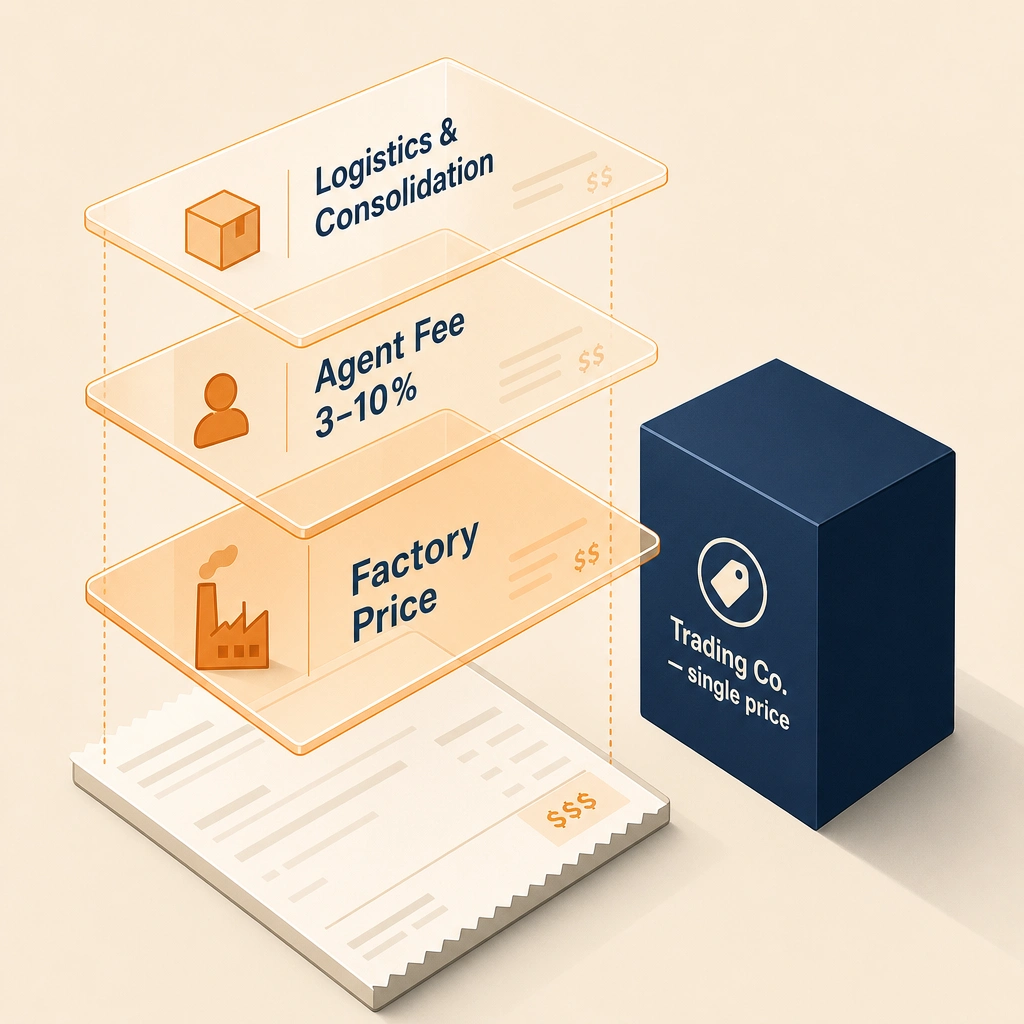
When a Trading Company Actually Wins
Trading companies aren't obsolete. There are scenarios where they save you money compared to either DIY or an agent.
- Tiny orders. Under $3,000, no customization, off-the-shelf product. The agent's minimum fee makes the math fail. Buy from a reputable trading company and move on.
- Categories where the trader holds real inventory. Some traders specialize in seasonal goods — Christmas decor, beach toys, garden tools — and stock units year-round. Buying from inventory means no lead time, no MOQ negotiation, no production risk.
- Buyer is brand-new and product-agnostic. If you're testing whether you can sell anything in a category before committing to a specific SKU, a trader's catalog lets you sample fast without supplier vetting overhead.
The mistake is using a trading company for what should be a sourcing agent's job: custom products, multi-factory orders, ongoing production, or anything with compliance requirements.
The 2026 Math: Which One Saves You Money?
For most importers, the answer depends on order size and complexity — not on the headline rate.
| Order Profile | Trading Company | Sourcing Agent | Direct (Alibaba) |
|---|---|---|---|
| <$3K, off-the-shelf | Convenient, low overhead | Fee minimums hurt | Doable if verified supplier |
| $3K–$10K, custom | Markup eats savings | Best fit + fee transparency | High learning-cost risk |
| $10K+, multi-factory | Can't consolidate | Consolidation = real savings | Coordination cost too high |
| Regulated/certified | Compliance opacity | Documented QC trail | Compliance risk too high |
| Ongoing production | No leverage on rework | Long-term price improvement | Possible after factory trust built |
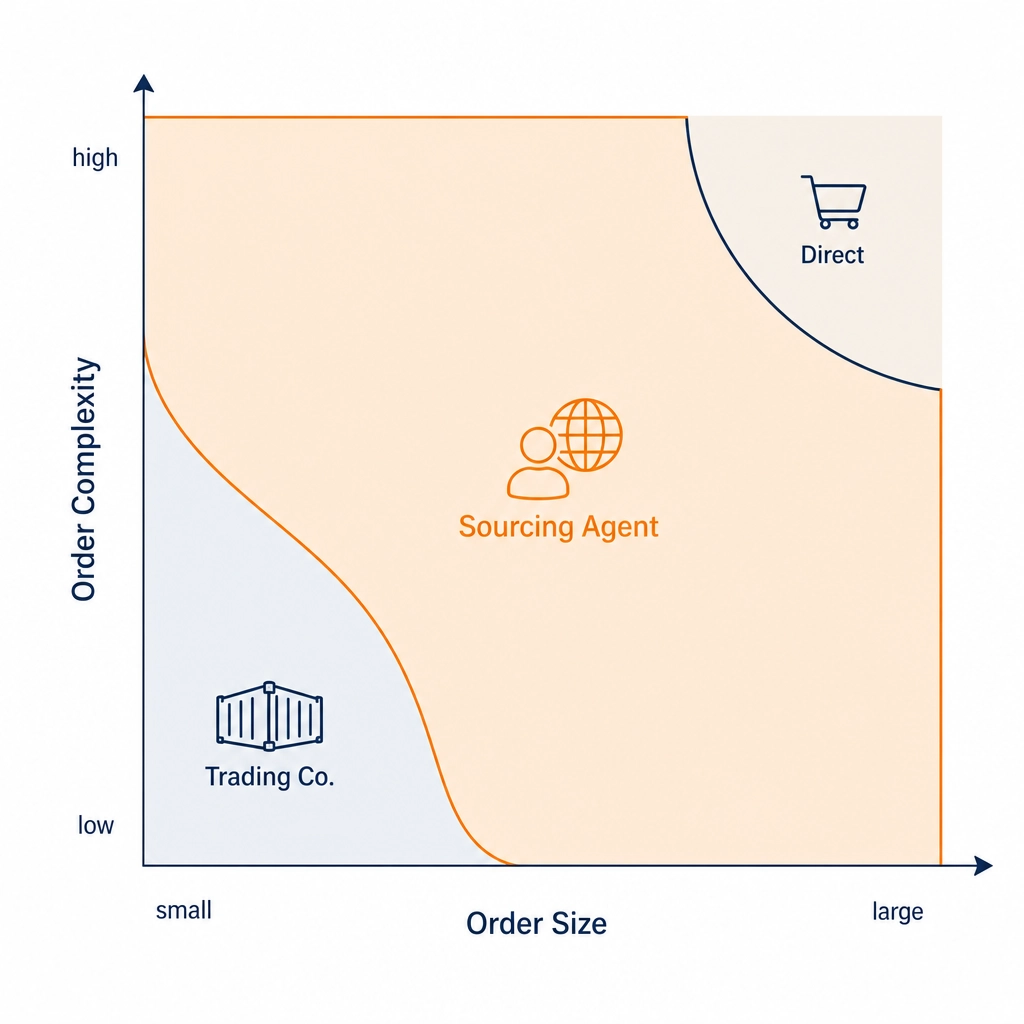
The pattern is clear. For one-off small purchases, trading companies hold their ground. For everything else — and especially for any buyer planning a second order — a sourcing agent's transparent fee almost always returns more than it costs. Buyers exploring the full sourcing-channel comparison usually arrive at the same conclusion once they map their order profile.
One Auckland wellness brand I worked with had been buying fitness equipment through a trading company for three years. Switching to a transparent agent dropped supplier costs by 40% — while adding a QC inspection layer the trader had never offered. The trader hadn't been "ripping them off." It just had no structural reason to optimize for the buyer.
How to Decide This Week
Forget the labels for a minute. The question isn't "trading company vs sourcing agent." It's: who has an incentive to find you the cheapest qualified factory and catch quality problems before they ship?
A trading company is paid more when the factory price is higher. A sourcing agent (a transparent one) is paid the same regardless. Whichever party's incentives align with yours is the party who saves you money — over the year, not just the order.
If you're sourcing under $3K of standardized product, a trading company is fine. If you're sourcing anything custom, anything compliance-sensitive, or anything you plan to reorder, the math overwhelmingly favors a sourcing agent — provided you vet and work with them like a skilled client, not a passive customer. Start with a $5,000 test order, demand an itemized cost breakdown, and judge by what they catch — not what they promise.
