


Yiwu International Trade City is the world's largest wholesale market — over 75,000 booths across 6 districts, covering more than 2 million products. Visiting in person gives you direct supplier access, real-time price negotiation, and hands-on product evaluation that no online platform replicates.
Where most on-site buyers go wrong
Without a clear process, buyers waste days in the wrong districts, place orders with middlemen they mistook for factory reps, and lose control of shipments after they've left China.
This guide covers the full on-site sourcing process from preparation to the moment your goods ship.
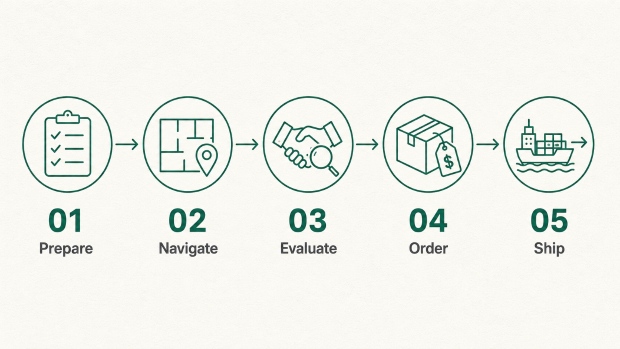
Step 1 — Prepare Before You Go
Good sourcing trips are built before you land. Buyers who arrive without preparation spend the first day getting oriented instead of evaluating suppliers.
Product Brief
For each item you plan to source, write down: target specifications, acceptable price range, required MOQ, and any compliance or labeling requirements.
Bring printed copies: physical documents are easier to share with booth staff than phone screens.
District Plan
Map your categories to specific districts before you arrive. Yiwu International Trade City spans 6 districts, each specializing in distinct product categories.
Attempting to cover all districts without a plan costs two full days.
Timing
Peak sourcing months are March–May and September–November. The market runs Monday to Sunday, roughly 09:00–17:00.
Avoid: Golden Week (first week of October) and Chinese New Year (January/February) — much of the market closes or runs at reduced capacity. Budget 2–3 full days minimum; multi-category trips typically require 4–5 days.
For a full breakdown of each district's product categories, see our Yiwu Market Guide.
Step 2 — Navigate the Market
Each district is a standalone building. Products within each district are grouped by category on specific floors. Once you find one supplier cluster, similar suppliers are nearby. Use this to compare quickly without crossing the entire market.
Move efficiently: identify 3–5 target booths per category, compare across all of them, then decide. Do not negotiate at the first booth you visit. Your leverage increases after you've seen the full price range.
Bring WeChat, a portable battery, a notebook, and business cards. WeChat is the standard communication tool for follow-up. Have it installed and ready to exchange contacts on-site.
Step 3 — Evaluate Suppliers at the Booth
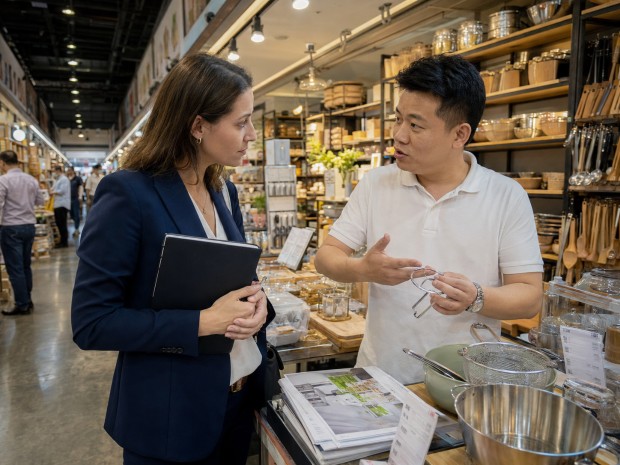
This is where most sourcing trips succeed or fail. Yiwu hosts both factory-authorized representatives and independent traders who resell products from multiple factories. The price, flexibility, and reliability you get differ significantly.
Factory Rep vs. Trader: How to Tell On-Site
| Factory Rep | Trader | |
|---|---|---|
| Product mix | Focused, consistent category | Wide, unrelated mix across booth |
| Production questions | Answers specifically (capacity, tooling, lead time) | Vague or deflects |
| Factory visit | Willing to arrange | Hesitant or unavailable |
| MOQ | Tied to production runs — higher but negotiable | Lower (drawing from pre-made stock) |
| Lead time | Weeks (production run) | Days (existing inventory) |
| Best for | OEM, custom, branded orders | Standard in-stock products, low MOQ |
Neither is automatically bad — know which one you need before you start evaluating.
Five Questions to Ask at Every Booth
Red Flags to Walk Away From
Refusal to provide a written quotation
If a supplier won't put their price in writing, you have no basis for comparison, negotiation, or dispute resolution later.
Prices significantly below every comparable booth
A 30%+ discount on a comparable product usually signals lower-grade materials, missing certifications, or quality compromises that surface after shipment.
Resistance to sample requests before a large order
A confident supplier wants you to see the sample. Pushback suggests they cannot consistently deliver the quality being shown on the shelf.
No capacity to communicate on product specs
For spec-sensitive products, language gaps become a specification-alignment risk — not just a convenience issue.
These booth-level signals are only the first screening layer. For a deeper supplier check, read our full guide on how to verify Chinese suppliers before sending a deposit.
Step 4 — Sample, Negotiate, and Place Your Order
Before committing to any order, request physical samples. For standard products, samples are often available on-site or within 1–3 days. For custom or OEM items, expect 7–15 days. So factor this into your trip timeline.
Negotiation
Yiwu suppliers expect it. The first quoted price is rarely the final price. Your leverage comes from order volume, payment terms, and competing quotes from other booths.
Tip: Long-term supplier relationships are a sourcing asset. Don't open with aggressive tactics — once a supplier marks you as a difficult account, you stop getting their best pricing and priority on production slots.
MOQ
Published MOQs are starting points. On standard products, many suppliers accept lower quantities for a first order, especially if you signal growth potential. On custom products, MOQ is tied to production economics.
Don't push too hard to compromise quality.
Payment Terms
Standard structure is 30% deposit to start production, 70% balance before shipment. T/T (bank transfer) is the dominant method.
Never pay 100% upfront with a new supplier
Full prepayment removes your only leverage if the order has defects, delays, or fails to ship. The 30/70 structure exists for a reason — suppliers who insist on full prepayment are either inexperienced exporters or hiding capacity risk.
Step 5 — After You Leave: Lock In the Order and Ship
Most sourcing problems happen after the buyer leaves, but don't happen in the market. This is where on-site buyers most commonly lose control.
Lock Specs in Writing Before You Leave China
Before departing, send each supplier a written order confirmation covering: product specifications, quantity, unit price, packaging requirements, delivery date, and payment schedule. Ask for written confirmation via WeChat or email.
Verbal agreements made at the booth are not enforceable
They are routinely misremembered by both parties. A Proforma Invoice (PI) from the supplier is the minimum acceptable standard — get it before you leave China.
Confirm Trade Terms Before Shipping
Before confirming shipping, ask whether the quote is based on EXW, FOB, CIF, or DDP. Many Yiwu booth prices are close to EXW-style product prices, meaning domestic transport, export documents, customs clearance, and international freight may be handled separately.
Clarifying the trade term early helps you compare suppliers more accurately and avoid unexpected shipping or documentation costs later.
Production Follow-Up and Pre-Shipment Inspection
For orders above $3,000–5,000 USD, schedule at least one mid-production check-in. A video call showing materials and work in progress is sufficient for lower-risk products.
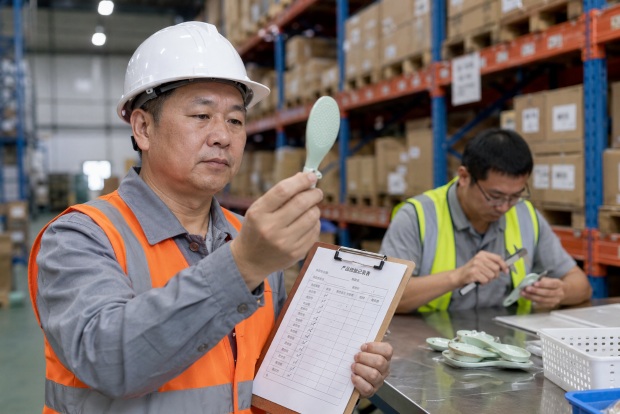
For higher-value orders, hire an independent quality control firm such as QIMA or an expert China sourcing agent like EJET Procurement to conduct a formal pre-shipment inspection. This is your last point of control before goods become your liability. Catching specification errors mid-production costs a fraction of what it costs to reject a finished shipment at port.
Shipping Options from Yiwu
Most buyers consolidate goods through a freight forwarder based in Yiwu. The official Yiwu market portal lists freight service providers operating within the complex.
| Method | Best For | Relative Cost | Est. Transit Time |
|---|---|---|---|
| LCL (Less than Container Load) | Orders under 10–12 CBM | Medium per CBM | 20–45 days |
| FCL 20ft | ~25 CBM+ | Lower per CBM | 15–40 days |
| FCL 40ft | ~55 CBM+ | Lowest per CBM | 15–40 days |
| Air freight | Small, high-value, or urgent goods | High | 5–10 days |
Build transit time into your inventory planning before you place the order, not after.
Common Mistakes to Avoid
Ordering without a confirmed sample
No matter how familiar the product looks, validate a physical sample before committing to full production.
Skipping written order confirmation
A WeChat thread with photos and specs is the minimum. A formal PI is better.
Underestimating lead time
Production plus sea freight can mean 45–75 days from order to delivery. Plan inventory around this.
Not allocating enough time
Two days are not enough for multi-category sourcing. Rushed buyers make poor supplier decisions.
Conclusion
Sourcing from Yiwu Market in person gives buyers a level of supplier access and negotiating leverage that remote sourcing cannot match. The process works when you arrive prepared, evaluate suppliers rigorously at the booth, and maintain written control of your order after you leave.
The two steps most buyers underinvest in: on-site supplier evaluation and post-order follow-through. There are places where real sourcing outcomes are decided.
Want a sourcing partner who manages the full process — from booth evaluation to pre-shipment inspection and freight coordination? Contact EJET Procurement to discuss your requirements.

FAQ
How many days should I plan for a Yiwu sourcing trip?
For focused, single-category sourcing, 2–3 days is workable. Multi-category buyers should plan 4–5 days minimum.
Do I need a sourcing agent to visit Yiwu Market?
Not required, but valuable for first-time visitors. An on-ground agent handles translation, supplier vetting, and logistics coordination. For a large first order, the agent cost is typically recovered in better pricing and fewer errors.
What is the typical MOQ at Yiwu Market?
Standard products can have MOQs as low as 1 carton or 50–100 units. Custom or OEM products typically start at 500–1,000 units per design.
Can I pay with cash at Yiwu Market?
Cash may be used for small sample purchases or minor stock orders. For larger production orders, buyers usually confirm a Proforma Invoice first and pay by T/T bank transfer according to agreed payment terms.
What is the best time of year to visit Yiwu Market?
March–May and September–November. Avoid Golden Week and Chinese New Year. Buyers interested in seasonal goods should consider aligning their trip with the Yiwu International Commodities Fair, held each October.
How much does it cost to hire a sourcing agent in Yiwu?
Sourcing agent fees in Yiwu typically follow two structures: a commission of 3–8% of total order value, or a flat daily rate of $80–$200 USD for booth visits and translation. Full-service agents who handle supplier vetting, quality control, consolidation, and shipping usually charge 5–10% commission, often with no upfront fee.
